AmberChess · Repertoires for Black
Budapest Gambit for Black
A weapon vs 1.d4 that is playable at every level and time control, designed to play with initiative and surprise opponents without drowning in heavy theory.
+600annotated positions
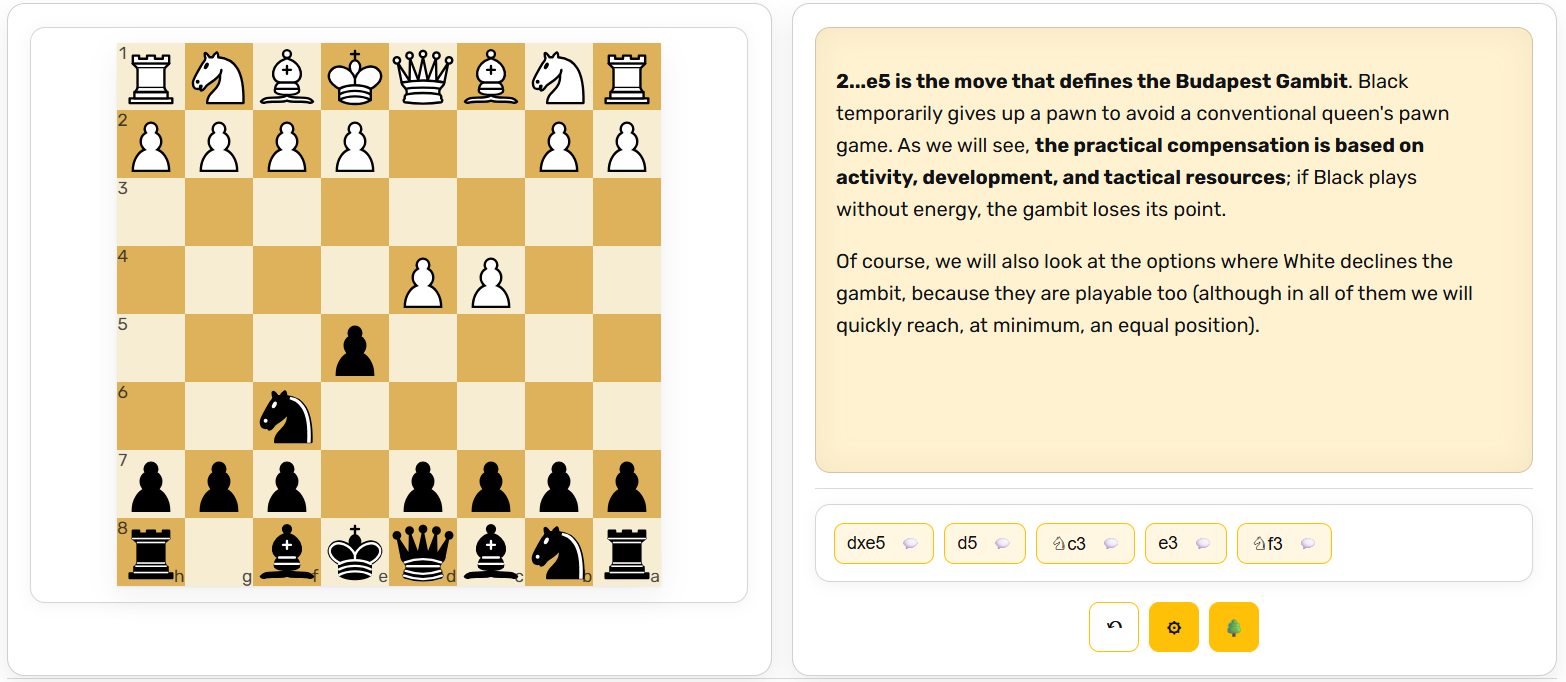
1.d4 Nf6 2.c4 e5starting point
4.Bf4 · 4.Nf3 · 4.e3 · 4.e4critical replies
The Budapest Gambit is a direct and practical way to answer 1.d4. After:
1.d4 Nf6 2.c4 e5
Black temporarily sacrifices a pawn to disrupt the type of game many 1.d4 players are looking for. The idea is to get a lively game from the start: quick development, active piecesand real chances for initiative against the enemy kingside, sometimes with creative and fun ideas such as the famous rook lift, one of the recurring themes of the study.
This pack is designed as a practical repertoire for Black: more than 600 annotated positions, explanations of plans, and answers to White's main decisions.
Train the Budapest Gambit in AmberChessWhat is the Budapest Gambit?
The Budapest Gambit appears after:
1.d4 Nf6 2.c4 e5
If White accepts with 3.dxe5, Black normally aims to recover the pawn with activity, following a very clear plan of rapid development and kingside pressure that can quickly become dangerous if White does not respond actively.
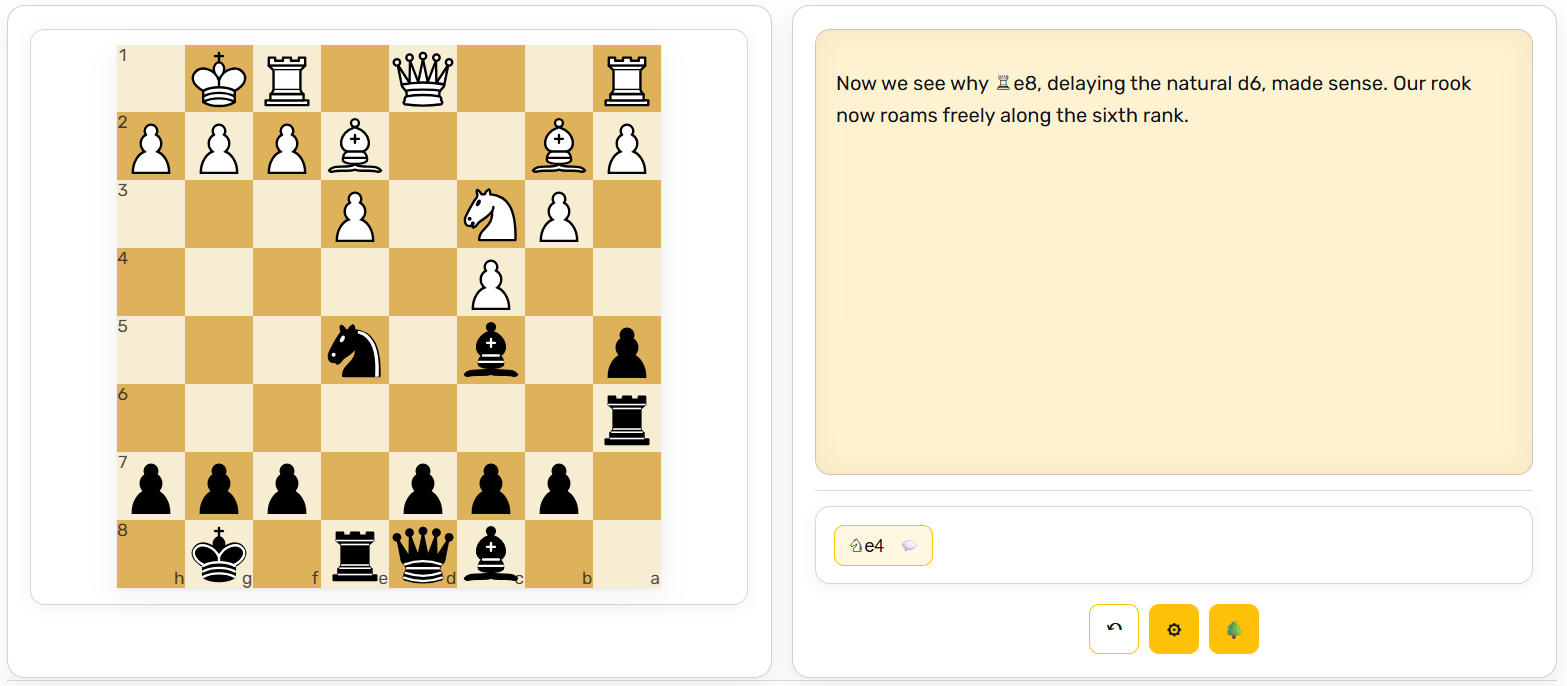
Black's move sequence, if not met by serious opposition, is simple and very effective: ...Ng4, ...Bc5, ...Nc6, ...d6, ...0-0, ...Re8, ...Qh4, ...a5, ...Ra6-h6... and Black's pieces coordinate very well.
Why play the Budapest as Black
The interesting thing about the Budapest is that it changes the tone of the game on move two. Instead of entering more familiar Queen's Gambit, King's Indian or Nimzo-Indian structures, Black asks an immediate question.
White has resources to equalize the game and even obtain a slight edge, but they are not always intuitive. In this study we have looked for Black options that, in the worst case against precise White play, lead to a position playable for both results, with everything still to fight for. Some positions may be assessed by engines as a small White plus, but in practice they are unbalanced situations where either player can prevail.
What this repertoire includes
The final Budapest Gambit for Black pack contains more than 600 annotated positions and is structured to cover, in practical fashion, the most important decisions White usually makes after 1.d4 Nf6 2.c4 e5.
In short, the repertoire includes:
- Budapest Accepted: 1.d4 Nf6 2.c4 e5 3.dxe5 Ng4, the main core of the study.
- Systems with 4.Nf3: one of White's most natural ways to defend without entering overly forced lines. Here we study the subtleties of when to try the rook lift with ...Ra6-h6 and when it is better to skip it.
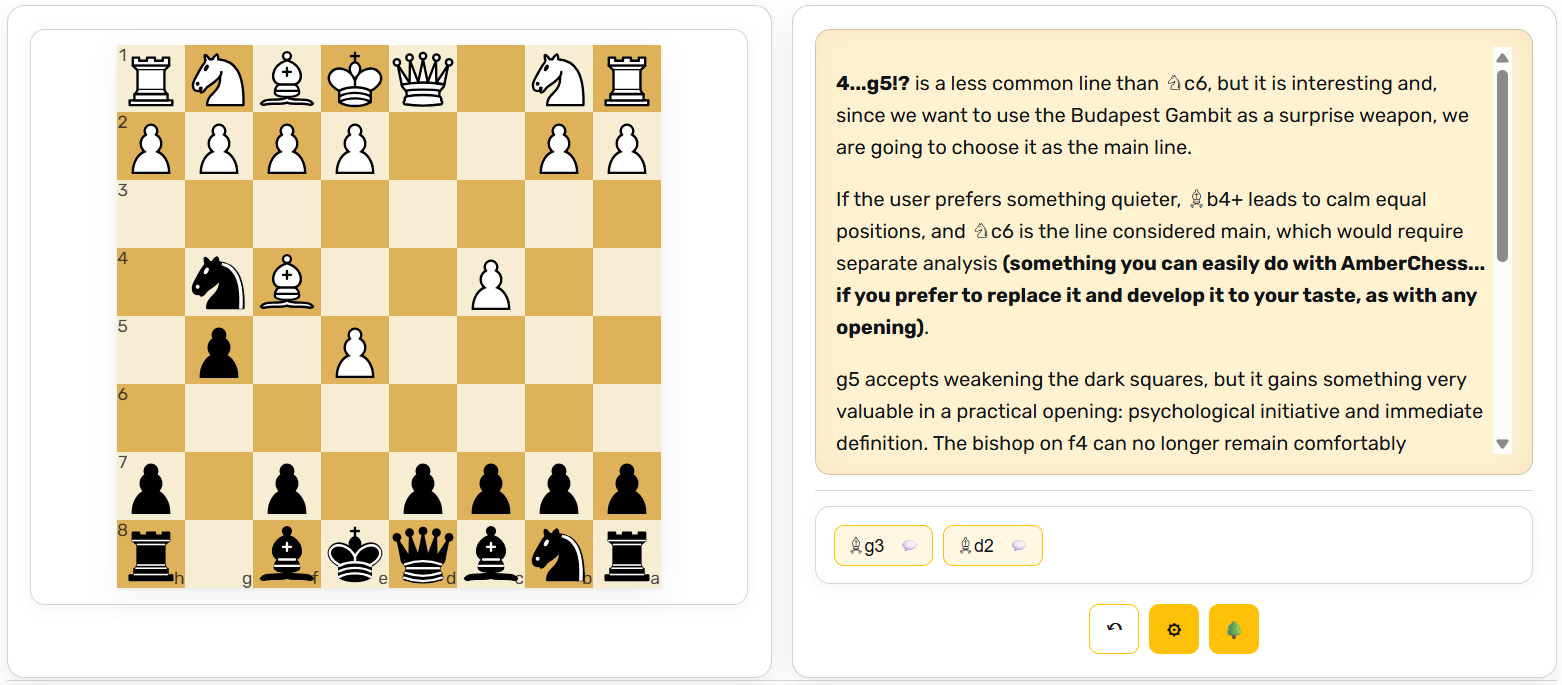
- Plans against 4.Bf4: our main choice is 4...g5!?, a practical surprise weapon that is also quite solid and playable at any level and time control.
- The 4.e3 system: a very solid reply for White, where Black must act energetically to keep the opening's active character.
- The ambitious 4.e4 system: positions where White builds a big center, but also gives Black clear targets for counterplay.
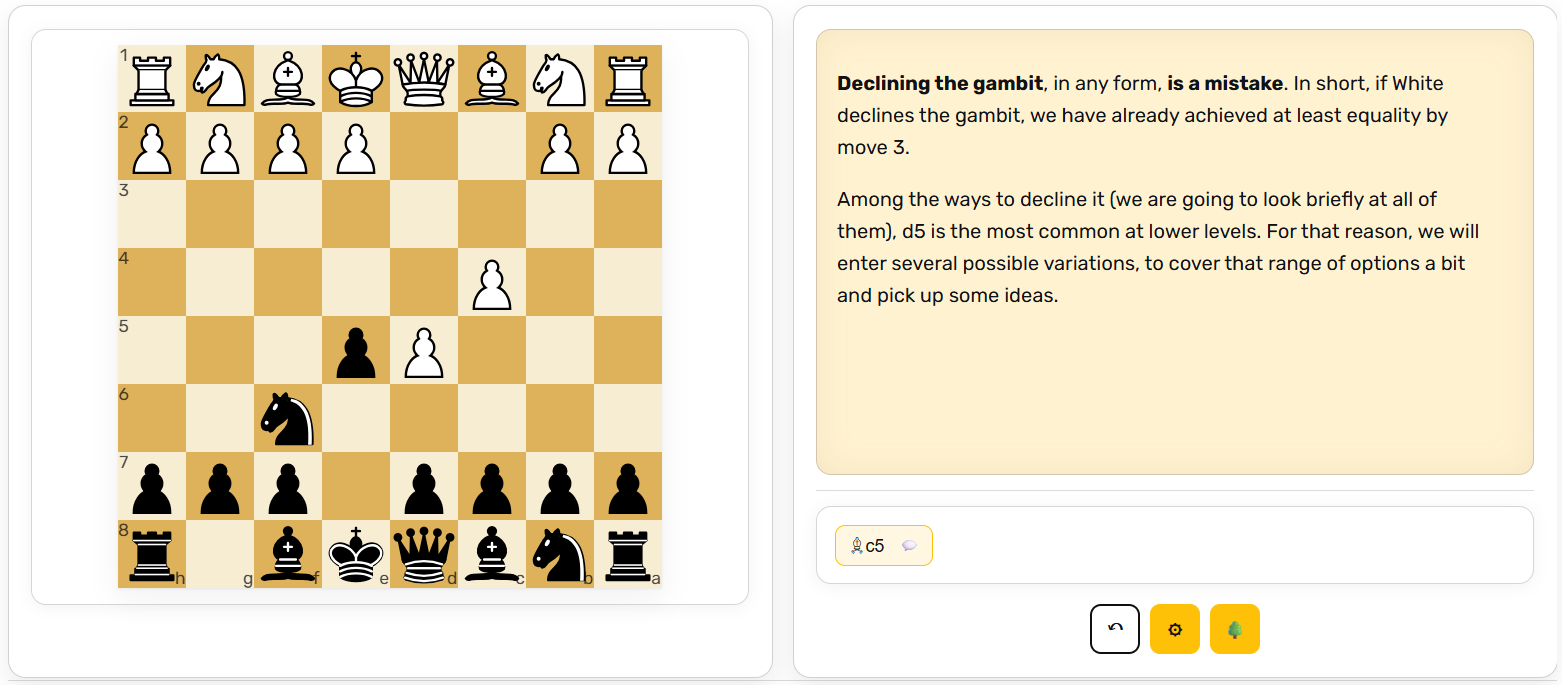
- Declined gambit: alternatives such as 3.d5, 3.e3 or 3.Nc3, with short and simple recipes for getting very comfortable play.
The accepted line: where the battle begins
After:
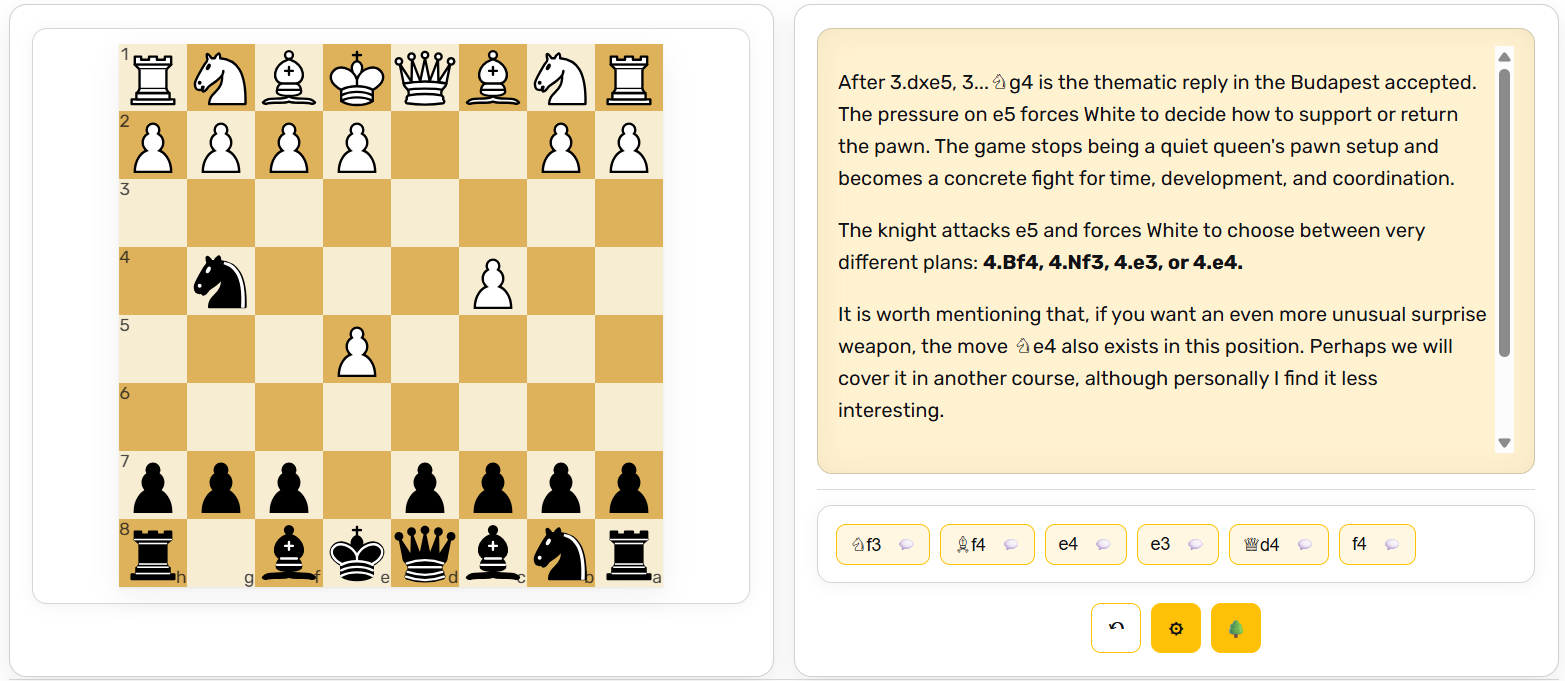
1.d4 Nf6 2.c4 e5 3.dxe5 Ng4
Black immediately attacks the e5-pawn. This is one of the most characteristic Budapest positions: White has won a pawn, but Black has won tempi and activity.
Here the pack explains how to respond to White's main options:
- 4.Nf3
- 4.Bf4
- 4.e3
- 4.e4
- other less common moves
Black's goal is usually to recover on e5, develop pieces quickly and prevent White from consolidating the material advantage under comfortable conditions.
The 4.Nf3 system
By far the most common choice at every level, but also one of the lines that best allows us to put our opening ideas into practice.
4.Nf3 is one of White's most natural ways to defend without entering overly forced lines.
Here we study the subtleties of when to try the rook lift with ...Ra6-h6 and when it is better to skip it.
The 4.Bf4 system
4.Bf4 is one of the most important replies. White develops a piece, defends the pawn and prevents the bishop from being locked behind its own pawn chain.
Here we choose 4...g5!? as the main option: a practical surprise weapon that is also quite solid and playable at any level and time control.
From here we analyze positions where the bishop retreats to 5.Bg3, or where it goes back to 5.Bd2. In each case the positions take on a different character and must be handled differently.
The 4.e3 system
4.e3 is a very practical way to play against the Budapest. The threat of the f4-f5 maneuver, and sometimes even f6, can allow White to take the initiative.
That is why this part of the repertoire matters. Black should not play automatically: they need a clear recipe to recover the pawn, develop the pieces well and avoid giving White a comfortable position. In this variation we choose a plan with a quick ...Nxe5, natural development, central pressure and structures where Black tries to equalize without losing the dynamic character of the opening.
If you want to take more risks, we point out that the interesting gambit 4...d6?! exists. Although engines consider it inferior, in practice it can be very suitable when you need to play for a win at all costs. With only a few mistakes from White, Black's position becomes very active and dangerous.
The 4.e4 system
4.e4 is an ambitious reply. White accepts more space and builds a big center. In return, that center can also become a target.
Here Black needs to understand very clearly what kind of game they want: attack White's center, recover the pawn under good conditions and provoke advances that leave weak squares behind.
When White declines the gambit
Not everyone accepts the Budapest. Some White players prefer to avoid the main line with moves such as:
3.d5, 3.e3, 3.Nc3
These lines should not scare Black. In many of them, the second player gets a reasonable game without allowing White to enter their favorite setup. The pack includes short recipes for these deviations, with plan-oriented comments: where to place the pieces, when to break in the center, and what type of structure to expect.
Who this pack is for
This repertoire is especially suitable if:
- you like active positions;
- you want to surprise your opponents;
- you are looking for a useful secondary (or primary!) defense that is easy to add to your repertoire.
It is a repertoire for surprising opponents and getting playable, dynamic positions with practical initiative against the enemy king.
Price and philosophy
The Budapest Gambit for Black pack is offered as optional support for AmberChess. You can import it for free in the app (1 free download pack per user) or support the project with a small contribution of 4 USD.
The idea is simple: keep AmberChess useful, accessible and subscription free, while also offering annotated repertoires for players who want to train openings in a more guided way.
FAQ
Is the Budapest Gambit good?
It is a practical and dynamic opening. It is not the most popular choice at the very top level, but it can be very useful for club players because it avoids a lot of mainline theory and creates concrete problems from the start. It also appears in major classical tournaments, so it is not a dubious weapon. It is a sound system.
Can it be my main repertoire against 1.d4?
It can work as a main weapon if you enjoy active positions and accept some risk. It also works very well as a secondary or surprise defense.
Do I have to memorize many variations?
That should not be the approach. The pack includes more than 600 positions, but the comments focus on understanding plans: recovering the pawn, developing quickly, pressuring the center and creating initiative.
What happens if White does not accept the gambit?
At minimum, Black should equalize comfortably. The pack also covers declined lines. The idea is that you are not left without a plan if White plays 3.d5, 3.e3, 3.Nc3 or other alternatives.
Train the Budapest Gambit in AmberChess
Import the repertoire, review the comments and practice the lines from Black's side. Learn an active answer to 1.d4 without drowning in theory.
Last updated: 2026-05-09 · packSlug: budapest-gambit-en